Bunnified News, Commentary, Social Criticism, Bunzo Journalism

RUNNING BUN MAGAZINE - All things "bunnified," news from the rabbit multiverse, deep down in the Earth, where it's still warm.

Monday, April 15, 2013

B!nk(y) - Animal Welfare Advocate

▀▄▀▄▀▄▀▄▀▄▀▄


How to Extend the Life of Your Pet Rabbit

How long could your beloved pet rabbit live? The answer is a lot longer than most people realize (we currently have a 16 year old rabbit!). With proper care, good sources of information, and qualified veterinary care, your pet rabbit could easily make it into his teens.

Generally speaking, the smaller the rabbit, the longer they live. Similar to dogs; where a large dog will only live about 7-9 years, so goes for a large rabbit. Where a smaller dog may live 16 to 18 years, so goes for the tiniest rabbit!

The Netherlands Dwarf is the longest-lived rabbit breed and also the smallest.
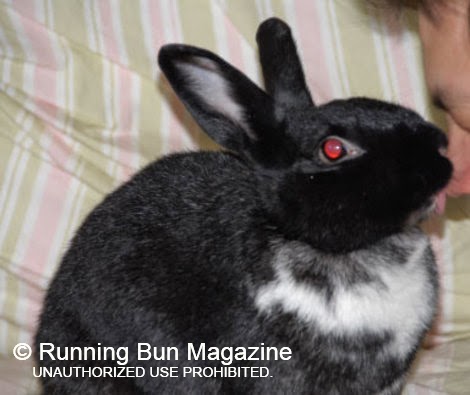
This silver marten marked palomino colored bunny can expect to live 10-15 years.
All content and images © Running Bun Magazine. Use without permission prohibited.
The smallest breed of rabbit is the Netherlands Dwarf which averages one to three pounds. The largest breed of rabbit is the Flemish Giant which averages 15-20 pounds. Both of these breeds are abundantly represented in rabbit rescue groups so you should be able to adopt either of these preferred breeds (please check Petfinder.com).

So why would someone want to adopt a large rabbit if you are looking for the longest-lived breed of rabbit? Well, along with being a large rabbit also often comes certain personality traits that are very popular such as a mellow personality, cuddliness, etc. Along with being a tiny, hyper-aware dwarf rabbit comes an increased flight response and heightened prey sense, thus, not so mellow or cuddly. However, of course, each rabbit is an individual and these personality traits can be found amongst any of the sizes of rabbits.

Now that you've found your preferred size of rabbit, how do you make sure you can provide for his maximum longevity? Provide the healthiest diet, lowest stress environment and best quality, qualified veterinary care you can. Not every veterinarian can successfully treat rabbits. Rabbits are considered 'exotic' by veterinarians, as are parrots and reptiles. These species are not covered in veterinary school and to learn about them requires internships with veterinarians who are exotic specialists. So research your vet carefully.
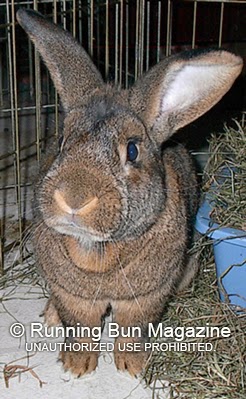
The Flemish Giant is a shorter-lived breed of rabbit. Being so large, often 15-20 pounds or more, they suffer from a variety of health problems including spinal concerns. They are often docile and sweet though.
All content and images © Running Bun Magazine. Use without permission prohibited.

 As for a healthy diet for rabbits. Take it from me, a veteran rabbit rescuer, the healthiest rabbit diet is comprised of 90% good quality horse hay or grass hays. Timothy hay, orchard grass, or brome hay provided in a variety of 'cuttings' - different qualities and sizes of leaf width will keep your rabbit's extremely delicate digestive tract humming along like an old Volkswagen.

A rabbit's digestive tract must always be in motion or it will shut down causing the rabbit to go into shock and die within a very short time, maybe just 12 hours. You will know this is happening because his poops will get smaller and smaller until they disappear and when that happens, it's too late. The main ingredient to keep this system humming along without causing obesity to the rabbit is the indigestible fiber from the hays mentioned above. These hays will also keep your rabbit's perennially growing teeth nice and trim. Well, you're probably wondering, 'I thought rabbits are supposed to eat mainly pellets?' That credo is from the meat rabbit industry which feeds rabbits a fattening diet to put weight on them as fast as possible as longevity is not a consideration.

This is not to say that rabbits don't, indeed, need pellets. They just need very little. The main reason to give pellets, which should be about 5% of the daily diet, is to provide a fortified source of nutrients in case the hays you are providing are of varying nutritional quality which happens with any crop. So the pellets are like vitamins for your rabbit and if you are feeding good quality fortified pellets, you shouldn't need to supplement with any other vitamins although there are plenty of these on the market. Just make sure those pellets are made from timothy hay and not alfalfa which is too high in calcium for adult rabbits.

The remaining 5% of your rabbit's daily diet should consist of appropriate vegetables which will provide more nutrients as well as provide enrichment and, hopefully, a satisfying culinary experience. Each rabbit is an individual and will have individual tastes, which may or may not be a good thing, so you will have to find out what your rabbit likes the best. The best vegetables to try are ones which will not cause gas. Gas attacks can be fatal for rabbits. Try to avoid cabbages; yes, they are inexpensive, but they also cause gas. Avoid spinach which is high in calcium, a mineral rabbits have trouble metabolizing and could, as a result, cause kidney or bladder stones or bladder sludge (ouch!).

Stick with the best, safest and most preferred vegetables; carrots - although these are fattening and so should be given in small amounts; romaine, green leaf, and red leaf lettuces are also wonderful and nutritious. Completely avoid iceberg lettuce which has no nutritional value and can cause runny stools. Cilantro is a favorite as well. Try to give organic whenever possible and when not, wash all of these thoroughly as rabbits are highly susceptible to pesticides.

And, of course, make sure you provide your rabbit with plenty of fresh, filtered water every day. You'll be surprised to know just how much water your rabbit actually needs to consume every day. Buy him the biggest water bottle you can find and fill it up with fresh water every day. Keep the bottle clean by using a bottle brush and untreated dish detergent such as Dawn or Palmolive (no antimicrobials containing deadly triclosan) or just scrub it with lemon juice (a natural antibiotic and disinfectant). Be sure to rinse it well before filling with drinking water.


When kept in altered (spayed or neutered) pairs, rabbits live longer, happier, healthier lives. They are highly social creatures and, in the wild, live in large groups called warrens comprised of sometimes several hundred individuals.
All content and images © Running Bun Magazine. Use without permission prohibited.

 Giving your rabbit a safe, warm, indoor, comfortable cage (no wire bottoms!) in a low-stress area (not too much hustle and bustle), and make sure they are spayed and neutered to prevent cancers (and bad behavior). Give him a couple of comfy litter boxes to nap in and use for necessaries. Doing this should provide your rabbit with an enriching and thus life-extending sense of happiness and well-being. Perhaps the most obvious but often most overlooked part of your rabbit's happiness and well-being is to provide them with a compatible mate of their own kind. Rabbits mate for life in the wild1 and thus having an altered (spayed or neutered) opposite sex mate keeps them happy and feeling safe and cuddling with their mate does wonders for their immune systems, just as it does for ours.


Now that you know what the keys to providing the basics required to ensure longevity for your companion rabbit, you can rest assured that your rabbit will live happily ever after.

Sources:
1 The Private Life of the Rabbit by R.M. Lockley, Introduction by Richard Adams, "They were not unusually promiscuous and in many instances retained the same mate for life."

 -RabbitPhotog
All content and images © Running Bun Magazine. Use without permission prohibited.

Sunday, March 31, 2013

Get the Picture? Chocolate Eye Candy!

http://www.zazzle.com/mr_chocolate_running_bun_magazine_cover_full_size_poster-228371650808717759?rf=238368801324753632  http://www.zazzle.com/mr_chocolate_running_bun_magazine_cover_full_size_poster-228371650808717759?rf=238368801324753632

▀▄▀▄▀▄▀▄▀▄▀▄

The Easter Bunny:
Silly Parents, Rabbits Aren't for Kids!


Every year as Easter approaches, parents and children alike get the idea that they'd like to bring the Easter bunny into their lives. Unfortunately, they often do this with little or no research, forethought, or even the idea that a life is at stake. Often the misconception is that rabbits have a short lifespan similar to hamsters or guinea pigs. Parents think they have a short-term project on their hands and that the kids will have a cute, cuddly, plush toy. Worse, some parents truly do consider this life disposable and that anything to increase their child's experience is well-deserved. The cost to the living being in question is an after thought.

In truth, rabbits do not make good pets for children. Although prey animals, rabbits will defend themselves and often kick, bite, and even scream while being endlessly mishandled by a child. In futile efforts to escape the unwanted embraces of rambunctious children, the rabbit will most likely also sustain an injury and often a fatal one at that -- such as a broken back or neck. The child also risks the potential for a very painful rabbit bite from those great big Bugs Bunny incisors.

A slightly more fortunate Easter bunny recruit may live a little longer only for the child, who is most certainly the caretaker of this little life, to lose interest in the animal and eventually start skipping feedings or allow the water bottle to remain empty or both. At long last, the bunny perishes from neglect. As a rabbit rescuer, I once took in a bunny from an animal shelter who was surrendered at age 8 years during which time he was cared for only by a very young child. He was so ravaged from this fate, it took him nearly a year and half to recover his health. He has since been adopted and is now being lovingly cared for by responsible adults.


Pinky was relinquished to the animal shelter at age 7 months. The relinquishing owner cited the reason for give up to be that he was afraid of his 5 dogs. Pinky was lucky and was rehomed with a lovely couple who are approaching retirement.
All content and images © Running Bun Magazine. Use without permission prohibited.


A common complaint to be heard from children who become disenchanted with their rabbit companion is that they are just plain boring. Terrified rabbits will sit in a hunched up position when they live in fear every day of their lives and do not do much of anything else. It's easy to understand why children craving interactivity would find this boring and also easy to understand why this is a successful survival strategy for a little prey animal. Eventually the rabbit's fear will impair his immune system and bring about an early demise. This happens very quickly for those unlucky buns who are imprisoned in the traditional backyard rabbit hutch. Exposed to the elements and predators, it is only a matter of time before they either die of a fear-induced heart attack - brought on by the sight or approach of a predator - or they succumb to the heat or the cold. The least lucky Easter bunny of all is the one whose uninformed family 'sets free' to be predated upon by a long list of natural enemies including skunks, raccoons, stray dogs, stray cats, coyotes, eagles, hawks, or owls. Getting run over by a car is also a possibility for the stray rabbit. The domesticated rabbit possesses none of the instinctual survival skills his wild ancestors did and also does not possess the same physical characteristics required for a life in the wild.

According to Kim Saunders, vice president of Shelter Outreach for Petfinder.com, "People know that dogs and cats end up homeless." Petfinder.com is the searchable database of homeless pets of all kinds. "We initiated Adopt-a-Rescued-Rabbit Month (February) to draw attention to the fact that rabbits are the third most likely animal to find themselves needing a new home. On any given day on Petfinder.com, there are over 5,000 rabbits available for adoption." 1 Some of these rabbits will be rehomed thanks to the efforts of shelter staff and volunteers but a great many of them will be euthanized through various methods because there simply are not enough homes for them.

Kathleen Wilsbach, president of the national rabbit rescue and education group, House Rabbit Society, informs us, "For the right people, rabbits are wonderful indoor companions. They get along with many other companion animals including gentle cats and dogs, are intelligent, affectionate and inquisitive, and can readily learn to use a litter box."

"However," she warns, "they can also be destructive. The ideal 'rabbit person,' in addition to being calm, patient and eager to get to know a rabbit on his own terms, must be willing to rabbit-proof an appropriate exercise area in the home to prevent damage from chewing."

Jules was relinquished to the animal shelter at age 2.5 years because his teenage caretaker left for college. He was released to a rescue group and adopted. A high-energy breed, he is an adorable mini-lop requiring lots of attention.
All content and images © Running Bun Magazine. Use without permission prohibited.
Rabbits do indeed make wonderful companions for older, more mature children whom are part of a responsible, caring family and include the rabbit as part of this family group. And while often as long-lived as a cat or dog, rabbits also require specialized veterinary care as they are considered by veterinarians to be among the 'exotic' pets such as parrots and reptiles. This is more costly than run-of-the-mill canine and feline veterinary medicine and also more challenging in a variety of ways for the rabbit caretaker. In a family where the rabbit's well-being and longevity are a consideration, a house rabbit will provide much good quality companionship and will endlessly charm his or her guardians with a happily twitching nose, bright eyes and bushy tail.

1 Petfinder.com Report of the Week, January 26th, 2008 
2 February is Adopt a Rescued Rabbit Month, http://www.rabbit.org/adopt-a-rabbit-month/adopt.html 


 -RabbitPhotog
All content and images © Running Bun Magazine. Use without permission prohibited.

Thursday, February 14, 2013

Bunoncé - Dangerously In Love With Bun-Z

▀▄▀▄▀▄▀▄▀▄▀▄

Secrets of Bonding Rabbits:
Matchmaking for Bunnies, Part 1


Finding a friend for your altered (spayed or neutered) rabbit is one of the most rewarding things you can do for both of you. In the wild, rabbits mate for life and in captivity, the same applies. A pair of bonded rabbits are endearing to watch and care for. Care must be taken in the process of matching one bunny to another or serious injury or worse can result. In this article, I'll detail my experience as a veteran rabbit rescuer who has done dozens of successful introductions (bunny matches) and bondings.

Bugsy, the silver Dutch, was highly aggressive toward all other rabbits. He fell head over heels in love at first sight with Juliette, the golden Palomino.
All content and images © Running Bun Magazine. Use without permission prohibited.


The Purpose of Finding a
Friend for Your Rabbit


Too many times I have had prospective adopters, people who have had house rabbits for many years, want to adopt a companion for their rabbit and they have no concern for whether or not their rabbit actually likes the other rabbit! They just have to have a certain rabbit and if their rabbit doesn't like the other rabbit, they want me to force the bonding. I no longer do this because of the trend I notice with these bondings which I'll mention later. What's the point of getting your rabbit a friend if...well...they don't even like each other?

Your goal in finding a friend for your rabbit should be to find the one rabbit whom your rabbit wants to be with. I have lived and live with rabbits who took a long time to find a friend because they were very selective. It's not that hard to understand the basics of what your rabbit's preferences might be if we remember a few simple rules of thumb.

1. Rabbits are heterosexual. After all the expression 'breeding like rabbits' isn't meaningless. Rabbits are characterized in mythologies all over the world as being a little too interested in procreation. So make sure both your rabbits are spayed and neutered before attempting any matchmaking!

(-update 7/4/14: we now believe rabbits can be whatever sexual, depending on their upbringing and history of treatment and altering. Regardless, it still makes sense to pursue the traditional avenues of lagomorph sexual behavior in these articles. Perhaps a Part 4 will look at the aforementioned issue, besides, I contradict myself in item 4 anyway!)

2. Rabbits mate for life. This means that your rabbit's preferences in other rabbits are probably not going to change much over their lifetime.

3. Female rabbits like male rabbits that are bigger than them. Rabbits are like humans in many ways and this is one of them. Sure there will be the occasional rabbit version of Prince (diminutive) whom all the rabbit girls will swoon over, but generally, the girls will go for a male who is larger than them.

4. Male rabbits will sometimes like other males for a friend. It's true. Sometimes male rabbits can be paired together without too much effort. Usually, though, this is true only for very young males, and of course, both males must be neutered. At other times, it's true for two male rabbits who have an omega (submissive) personality. Some people insist that their male rabbits actually prefer other male rabbits over female rabbits but this is usually because of poor socialization as a baby. That nervous, high-strung male rabbit should be with an experienced female rabbit who knows how to reassure a nervous boy.

5. Rabbits of the same breed or markings tend not to get along. Oddly enough, in my experience, when introducing a male and female of the same breed, it tends not to work out. Rabbits seem to be attracted to other rabbits who do not look like themselves - I suspect they think different looking rabbits are 'exotic' - kind of like how I think Prince is exotic (and therefore hot).

6. Rabbits who appear to be aggressive with other rabbits are highly selective. The rabbit who is highly selective is simply waiting for Mr. or Miss Right. When that magic rabbit is found, the seemingly aggressive rabbit will usually end up being the submissive one of the pair! The trick is finding the one rabbit that this highly selective one will fall head over heels in love with.

7. Love at first sight is rare. Yes it is rare and with some rabbits, you could look for years and not find another rabbit that your rabbit will fall head over heels in love with. It just means your rabbit is coy and wants to be courted; your rabbit has a Victorian sense of choosing a mate.

Teesa (white w/brown spots) snagged the highly desirable Cisero. Every female rabbit who ever laid eyes on him swooned over this little Netherland dwarf boy.
All content and images © Running Bun Magazine. Use without permission prohibited.


In preparation for introducing your rabbit to potential mates, be sure you take him to the vet first. Make sure your vet is a qualified rabbit veterinarian. Have your rabbit tested for common rabbit parasites and evaluated for any symptoms of infection. Common parasites to look for are giardia and coccidia. Some vets will tell you that giardia is not found in rabbits, but it is now and being seen more commonly.

Also be sure that any rabbit your rabbit is being introduced to has also been vetted and tested for these parasites. If you are working with a rabbit rescue, make sure they are a legitimate rescue and ask if they test their rabbits for parasites prior to introducing them to other rabbits. It's not worth the risk of exposing your rabbit to sick rabbits in order to find him a mate. You could end up losing your little friend this way.

Also check any rabbits you may introduce your rabbit to for signs of nasal or respiratory infection. This includes wet fur around the nostrils or nasal discharge of either clear or white color. Many rabbit diseases are airborne and thus very easily spread. Regardless of where you obtain a friend for your rabbit, these are concerns to be aware of. All rabbits everywhere are very susceptible to these diseases.

Choosing a Bunny Marriage Broker


Try to enlist the aid of the most experienced rabbit bonder you can find. This person will most often be a rabbit rescuer who will help you with the bonding of the two rabbits. Beware of anyone who claims that any two rabbits can be bonded. While it may be true and possible that any two rabbits can be forced to coexist, the stress involved with that process can impair the immune system of the rabbits and often the rabbit who assumes the omega, or submissive, role will develop stress-related illness and not live very long. Your goal should be to find a bunny that your bunny wants to be with and doesn't need to much coercion. I always say the best bonding is a non-bonding. Your concern should be for the welfare and happiness of both rabbits.

Picking an experienced person to match and bond your rabbits is a process in itself. You should talk with this person and try to assess if they seem to have a natural affinity for animals. Does this person seem to place concern for the happiness and well-being of both rabbits above all? Or is this person trying to find out what you want? "Animal people" are often not "people people" so try to excuse any boorish personality traits which you may find annoying about this person. The important thing is that they properly assess the behavior and personalities of rabbits. I can tell just from the personalities of two rabbits who haven't yet met if they can be friends. This is because I've done so many matches and introductions that I recognize which types of personalities go together well. But as with any skill, I am still always learning and there is always a rabbit whose personality and life experience is so unique that I learn something new.

Another factor that should be important to you in choosing a bunny marriage broker for your rabbit is if the person is willing to do the match and bonding for you regardless of whether you are adopting from them or not. Some rabbit rescues will not take kindly to your adopting from another rabbit rescue but if you are adopting from a shelter and saving a bunny, they will be happy with that. However, most experienced rabbit bonders are rescue people and will not be interested in helping you bond your rabbit with a rabbit from a breeder or pet store. The idea behind the matchmaking of two altered (spayed or neutered) rabbits is to help the rescue organization save another life. If you are a member of a rabbit rescue, they should be happy to help you meet all of their bunnies but it might not work out with any of them. You might have to keep looking beyond their rescue to another rescue. Hopefully these rescues are both interested in serving your rabbit's needs. It can be a tricky situation to work with more than one rescue this way but a little tact and diplomacy go a long way.

Jenni (brown sable) violently rejected all suitors until the strapping Jar Jar came along. She charged at him intending to box him with her paws and he sat on her head. She fell in love instantly.
All content and images © Running Bun Magazine. Use without permission prohibited.

Pairs, Trios and Quartets


Rabbit rescues are wonderful organizations whose mission it is to save the lives of rabbits. Rabbits are the third most abandoned companion animal after cats and dogs and so are found well represented in animal shelters and rescues throughout the US and many other countries, especially the UK. They are also euthanized in these shelters. A good strategy for these rescues is to encourage matching up multiple rabbits in pairs and trios and even quartets. More lives are saved this way. Matching and bonding trios and quartets is an entire article in itself and so will be the last part of this series. There are advantages and pitfalls of matching your rabbit into a trio or quartet and I will cover these later.

What About Your Grieving Rabbit?


A very common scenario with rabbit matchmaking is when one of a pair has died and the caretaker is seeking a new mate for the survivor. Rabbits grieve in different ways. Often when one rabbit dies, the other one may die, literally, of a broken heart if a new mate isn't found soon enough. Grieving symptoms include aimlessly staring out windows or off into space, lack of appetite or listlessness. Some rabbits need time to grieve, others will suffer if they have to wait too long for a new friend. You should know your rabbit and be able to assess when it is time. It is important too if you are grieving very hard and you need your rabbit to find a new friend sooner rather than later for your own happiness. Both of you are important and have needs. Just try to leave the matchmaking to the pro and let your rabbit choose his or her new love.

In Part II of this series, I will cover very specifically what actually happens at the match and how to recognize if your rabbit likes another rabbit. In Part III, we will discuss how to actually conduct the bonding (bunny moon) for those who do not have an experienced rabbit bonder in their area to help them. Stay tuned!

 -RabbitPhotog
All content and images © Running Bun Magazine. Use without permission prohibited.

Friday, August 31, 2012

Rabbit, Heart So Bright: Caring for a Disabled Rabbit

 Glenna the Good


▀▄▀▄▀▄▀▄▀▄▀▄


Caring for a Disabled Rabbit

Rebecca had to wear diapers during the time she was disabled because she was incontinent. She was very comfortable in them.
All content and images © Running Bun Magazine. Use without permission prohibited.


Recently I was conducting an adoption through the shelter where I volunteer and brought up the subject of what it's like when a rabbit becomes disabled and how to care for them at that point. The adopter asked, in all innocence, "Is that really humane?" That question had never really entered my mind. So many of the 'rabbit people' I know have dealt with disability in their rabbits with so much success that I had never really stopped for a minute and thought about this question.

So I did stop that minute and thought about it. Yes, of course there are times when we must carefully weigh the quality of life for our companion animals but quality of life is measured in many different ways. When you have companion rabbits or 'house rabbits' (as opposed to hutch rabbits or livestock rabbits) and they start getting older and possibly become disabled, this happens most often because you have invested a lot of time and energy and usually money into their welfare and well being and they have the luxury of growing old (see my article on extending the life of your rabbit) - something a wild rabbit does not usually experience.

Measuring the Will to Live


A rabbit who is happy and has a will to live is one who eats with gusto. A rabbit who is sick or has given up on life, does not eat and simply waits to die which happens quickly when their intestinal tract shuts down. Many times during a long-lived rabbit's life will an owner find themselves force feeding or 'assist feeding' their rabbit through a period of illness. However, a rabbit who truly has lost their will to live cannot be successfully assist fed; they just let their mouths hang open and as soon as you syringe feed some food into their mouths, they just let it come right back out. When this happens, you know your rabbit has given up and does not want to live. Critical Care, manufactured by Oxbow Hay Company, is a special prescription formula food designed for assist feeding rabbits and other herbivores during periods of convalescence - usually before and after surgery. This formula contains special appetite stimulants and probiotics (as opposed to antibiotics) to encourage the rabbit to begin eating on his own again. If a rabbit has truly 'signed off,' this will be unsuccessful. A rabbit who cannot be encouraged to eat will take his own path to the other side and there's not usually much the best veterinarian or most caring owner can do about it.

So if you find yourself with a disabled rabbit who eats his hay and veggies heartily every day, maybe needing to be assist fed for dental reasons or possibly a temporary tummy ache, then you know that your rabbit has a will to live and wants to stick around and enjoy whatever special accommodations can be arranged for him. So, yes, it's humane and in fact, it's an implicit contractual understanding called domestication. The mutual benefit of domestication is what we have to remember here. For domesticated companion rabbits, the benefit to humans is that we have a steady and faithful, often entertaining, friend, whom we love. The benefit to the rabbit is longevity achieved through safety from predators; basically, we remove them from the food chain and put them on a pedestal. They like this, even relish it and their eating habits are the main indicator of this.

When Rebecca started to regain the use of her hind legs, I extended her quarters to include a waterproof-padded area with additional litter boxes.
All content and images © Running Bun Magazine. Use without permission prohibited.

When is Life Extension Not Justifiable?


Now that I've established that life extension for a disabled rabbit is humane, I should add that it can be taken too far which was most likely the concern that my adopter was expressing. This adopter is a great and wonderful rabbit lover but she also has the presence of mind to be able to stop and think for a second, 'wait, is this a good idea or would I just be doing it for my own emotional needs and disregard the desires of my animal?' After all, the thing about death is that it usually is a long, drawn out process involving much suffering and many people and animals show signs of wishing there was a way to ease the transition involved and minimize the pain. That's why veterinarians practice euthanasia after all, to bring dignity to this process. Deciding when it's time to call it quits is an art form many of us spend a lifetime learning.

For the most part, rabbits who are suffering and have no will to live usually pass pretty quickly without any need of assistance. Many rabbit owners have experienced the horror of sudden death - a phenomenon in rabbit keeping - and have not had the luxury of practicing life extension for their rabbits because, as prey animals, they hide the symptoms of their illness so skillfully. With the exception of a few conditions, rabbits will pass pretty quickly once they've contracted a painful, terminal condition. One condition, however, that rabbits do tend to struggle with causes partial paralysis and this is the protozoan blood parasite, e. cuniculi. The very initials, e. c., strikes dread into the heart of a rabbit lover. It is estimated that half of all rabbits carry this parasite in their blood but not all of them show symptoms of infection which include paralysis and other neurological signs such as head tilt, rolling eye, and wobbly gait. The ones who show no symptoms are said to have a sub-clinical infection or one that is unobservable through symptoms; aka 'asymptomatic.' Many rabbits stricken with clinical infection from this disease find themselves with no or very limited hind end mobility or partial paralysis. We will focus on mainly this type of disability in this article for it is by far the most common.

Rebecca was a stray rabbit who lived outside for several years. By the time we caught her, she was ill and soon became disabled.
All content and images © Running Bun Magazine. Use without permission prohibited.


On the Road Again


There are several companies who manufacture pet wheelchairs for animals with no hind end mobility. When my Sanctuary rabbit, Rebecca became partially paralyzed with e. cuniculi, I special ordered a wheelchair for her (see photo) from Doggon' Wheels. Other companies who manufacture similar products include K9carts, and Dewey's Wheel Chairs for Dogs. It can be difficult to accurately measure a partially paralyzed rabbit for one of these carts because they often tend to be very skinny in the butt. I have known of several rabbits who did very well with these carts and get around famously. Rebecca did not like hers although she was able to get around pretty well with it. She hated it for the most part but it inspired her to get better, which she did. If, in the future, I have another rabbit become disabled in this way, I will get them another cart.

While Rebecca was not in her cart, I made her a special habitat which she would be comfortable lounging in. An inexpensive under bed storage bin from Walmart became an extra long litter box. I put about 2 inches of aspen bedding in it and then placed artificial sheepskin atop the litter. The purpose for doing this was to keep her from being stuck in the same spot she had just peed in. The artificial sheepskin is porous and liquid flows right through it while remaining dry. So it made an excellent diaper surface for the litter box and protected her sensitive skin from urine scald which is a big concern for incontinent rabbits. She did suffer some urine scald at first while I was learning how to best care for her and also required daily butt baths for a while.

I bought her a baby bathtub for the sink and every day I would wash her bottom in warm water using a bit of hand soap and gently clean off the urine and poop that would become stuck to her bottom. I used a hair dryer on cool setting, so as not to burn her skin, to dry her bottom and also used lots of plushy towels. Sore, chapped skin on her bottom was soothed with Aveeno Diaper Rash Cream. It was easy to see the look of relief cross her face when the cooling diaper rash cream was spread on her tissue-thin skin.

This special litter box was setup to accomodate Rebecca's needs. The fake sheepskin allowed urine to pass through while it stayed dry.
All content and images © Running Bun Magazine. Use without permission prohibited.

Living Large in the Litter Box


In case she didn't feel like lounging in the litter box all day, I special ordered her a waterproof bed pad which was originally manufactured for elderly incontinent persons. This was the not the cheap waterproof padding you can find at Target or Walmart, I ordered it from a medical supply website. The pads are washable over and over again and protected my wood floors from accidents. When she felt like coming up on the bed to watch a movie with me, she donned a size 1 (4-6 months) Huggies diaper. She poops quite a lot and so the poops in the diaper protect her bottom from urine scald.

Along with providing Rebecca with supportive care during her paralysis, I provided her with the absolute best in exotic veterinary care (see my article on selecting an exotic veterinarian for your rabbit) and I also complemented this top care with alternative medicine by working with a master herbalist (who also has rabbits) who designed an immune system boosting formula which helped Rebecca fight the dreaded e. cuniculi. In addition to both of these, I also performed physical therapy.

During the partial paralysis that so often accompanies e. cuniculi, muscle atrophy takes its toll on the rabbit's powerful hind legs and decimates them. To counter this as best I could, I would lie Rebecca atop a waterproof pad on my bed on her side and stretch and pull her hind legs. I stretched them out as long as they would go and tickled the tips of her toes while I did so to stimulate her nerves and cause involuntary muscle reactions. She made every effort to work with me during this process. Then I would push her leg back in toward her body with the palm of my hand, encouraging her to try and push on my palm with any strength that she had. She slowly developed some strength in her muscles from pushing on my palm. After about 6 weeks of antibiotics, herbal formula, physical therapy, and some inspiration from the hated wheelchair, Rebecca started taking little hops on her own. Two months later, she was hopping on the bed unassisted and proudly surveying the room from her perch.


Hoppily Ever After


She would go on to hop all over the house, albeit a little clumsily, for another two years and then she had another bout with e. cuniculi; this time causing head tilt. She was put on double antibiotics, steroids and herbal formulae again and again she triumphed, now no longer showing any signs of head tilt. However she does clomp around a bit more clumsily and her hind end mobility is again on the decline. She has developed a pressure point on her right hip from leaning just a bit to the right when she hops. This hip hits the floor each time she does her little old lady hop. An abscess nearly developed on the site of this pressure point and so she occasionally wears diapers now to cushion her bony butt and protect this pressure point from callusing and developing an abscess.

Here, Rebecca has hopped on the bed on her own and kisses her human daddy.
All content and images © Running Bun Magazine. Use without permission prohibited.
I imagine old Rebecca, who had been living as a stray for several years in our backyard when we bought our house, and another few more until we caught her, still has quite a few hops left in her. Through all of this, she has eaten heartily and with gusto. She is an inspiration and is a dear friend. We like to watch chick flicks together. We like happy endings. It is all very humane.

P.S. IMPORTANT POSTSCRIPT: When caring for a rabbit in this manner, it's imperative that they be assist fed their cecals if they are unable to reach for them on their own.


 -Thumper S. Thompson
 
All content and images © Running Bun Magazine. Use without permission prohibited. 

See more of this issue's content.

Monday, July 4, 2011

Harry Bunnick, Jr.: The Crooner Speaks

▀▄▀▄▀▄▀▄▀▄▀▄

The Importance of
Spaying or Neutering Your Rabbit

So you brought home a little bunny. You acquired all the accoutrements he or she could possibly want or need according to 21st century companion rabbit care. He or she should be very happy. Actually, you aren't sure whether you have a girl bunny or a boy bunny. Rabbits can be hard to sex when they're young but sooner or later, there are two very distinct indicators of the presence of a male, and in rabbits, they are usually quite pronounced.

So that being established, now you think to yourself, 'well I don't have to get him or her altered, I am only going to have one rabbit.' Let me say, I hope you do get him or her a rabbit buddy. Rabbits are highly social creatures, and, in the wild, which is in Europe as rabbits are not found in America except for the tiny pygmy rabbit, they live in groups of dozens or hundreds in large underground warrens. So a single rabbit must get lots of human attention to satisfy his social needs and even then rabbits like to have a buddy to snuggle. Don't you?

Well, still, you're thinking that you don't need to get your rabbit altered. It can be expensive and hard to find a vet who is experienced enough to handle this delicate surgery. Save yourself the mistake that so many others have made in waiting too long to get their rabbit spayed or neutered. Left to develop strong mating, nesting, and territorial instincts, hormones kick in around age 5-6 months and after that, for some behaviors, there's no turning back.

Girls Will Be Girls

Cecilia was abandoned at the vet's office at age 9 suffering from uterine cancer. She was successfully spayed and lived another year and a half, dying from other causes.
All content and images © Running Bun Magazine. Use without permission prohibited.

Females will develop nesting behaviors which present with digging. They will also aggressively guard their sleeping or nesting bed. Chewing becomes an important behavior as the rabbit matures; he or she wants to shape their space and put their chew marks upon it. This could be your baseboard or furniture that is suddenly a victim of rabbit graffiti; lots of little nibbles done in bas-relief style. Or it could be your carpeting. Rabbits love to pull grass blades out of the ground and indoors, your carpet is the next best thing.


Males will spray urine like cats but with the precision of a skunk. Some are able to hit a bullseye from ten feet away - similar to a skunk's infamous aim. Males may also 'oink' like a little pig to express displeasure. And they may start to 'box' with you. In the wild, male rabbits often fight to the death over a mate whom they often retain for life. And so it seems they invented pugilism along the way.

Sadly, female rabbits suffer an 85% chance of developing uterine cancer if not spayed by the age of five.1 When uterine cancer sets in, it spreads to the lungs and the female rabbit dies of suffocation. This is an incredibly sad and pathetic thing to witness.

All of these problems mentioned above are preventable and, for the most part, remedied through the procedure of sterilization. Males cease immediately the spraying of urine. Female nesting behavior diminishes along with much of the territorial aggression and chewing behaviors. Vestiges of these are the essence of rabbit existence, however, and so you will not see a 100% reduction in the hormone-induced behaviors being discussed here. Trace behaviors such as these can be redirected to chew toys. However, a strong reduction overall in undesirable behaviors can be expected. Cancers are also eliminated as a future health problem.

Boys Will Be Boys


The most dramatic benefits of neutering a rabbit are the vanquishing of hormonal humping and aggression. I have seen highly aggressive males, once neutered, display the most positive attributes you can possibly imagine. From a boxing, biting, spraying buck, the male often transforms into a gregarious, amiable individual. Nesting obsessed females will still retain the sense of sacred space for their bedding but they will lessen this dramatically and exhibit a sense of sisterhood or sharing with their family instead.

All in all, the benefits of altering your rabbit, whether living singly (hopefully not), or in heterosexual pairs (preferred natural state though same sex is sometimes best) are well worth it. In fact, like with our cat and dog friends, altering is what makes them pleasant house pets. So don't short change yourself or the rabbit, get it done and enjoy the resulting wonderful, magical personalities of these charming creatures.

Petruchio is a Netherlands dwarf house rabbit who humped his (spayed) mate so incessantly that she sustained a head injury. Altering removed this behavior.
All content and images © Running Bun Magazine. Use without permission prohibited.

Special Vets


That being said and established, getting it done is a tricky business. Rabbit vets must have trained especially in rabbit spaying in order to successfully anesthetize a rabbit. This is not taught during the usual curriculum of veterinary school. It is given as part of continuing education and through internships with exotic vets. Carefully research your choice for a rabbit veterinarian as it is the single most important decision you make regarding your rabbit's life.

With an altered rabbit lounge lizard on your living room hearth, you will enjoy the gentlemanly or lady like qualities of these fine companion animals for many years.

Sources: 
1 Uterine Adenomata in the Rabbit by Harry S. N. Greene, M.D. & John A. 
Saxton, Jr., M.D. (From the Department of Animal and Plant Pathology of 
the Rockefeller Institute for Medical Research, Princeton, New Jersey)

 -Thumper S. Thompson 

All content and images © Running Bun Magazine. Use without permission prohibited.

Wednesday, June 9, 2010

Sanctuary Rabbits: Glenna "Unfinished"

 Glenna the Good


▀▄▀▄▀▄▀▄▀▄▀▄


Glenna "Unfinished"

The other day in looking at Miss Glenna Bun, sitting in a ray of sunlight streaming in through the window, it occurred to me, as light glowed around her spiky ears, that she looked like a painting left unfinished. Many of the old masters, and even contemporary ones, would purposely leave a work unfinished. Mary Cassatt did that once or twice and it was thought to show the rest of the painting had a depth and dimension which critics were expected to quickly dismiss. So the unfinished part of the painting was the artist's way of saying to the short-sighted critic who would be long forgotten while the master painter's works would live on and gather appreciation over the decades and centuries, 'well, do you prefer blank canvas? then be appeased.' But really the unfinished part of the painting forced the viewer to appreciate the richness of those parts of the canvas graced with pigment by way of the stark contrast between blank and painted canvas.

So that is what I thought of suddenly, one afternoon as the sunlight filled her little ragged ears like glass cups which had been shattered on the rims - she was "unfinished" and those unfinished parts of her, the ears, made me appreciate the rest of her all that much more. And so when I snapped this little photo of her in a similar light, her lips stained bright pink with carrot juice, making her look like one of the women Henri de Toulouse-Lautrec might have painted (oh my!), I couldn't help but render it with a quick digital colored pencil. Her sweet little expression is still clear though. And that part is complete.

Soaking Up the Love - or is it just begging for another Barley Biscuit?

She likes to lie next to me while I work on my laptop and have me stroke her ears. They have some fur growing on them. I have this intense compunction to sprinkle them with gold glitter and paste a few rhinestones on them. Maybe for Halloween! Stay tuned!


 -RabbitPhotog

All content and images © Running Bun Magazine. Use without permission prohibited.
 
See more of this issue's content

Saturday, June 5, 2010

Thumper S. Thompson - The Rabbit Bill of Rights!


▀▄▀▄▀▄▀▄▀▄▀▄


Rabbit's Bill of Rights - A Bright Eyes Sanctuary adaptation (with permission) of The Parrot's Bill of Rights as drafted by my dear friend, Stewart Metz, M.D.


Preamble...Until he extends the circle of compassion to all living things, man himself will not find peace.
- Dr. Albert Schweitzer


Article the first...GET TO KNOW ABOUT RABBITS BEFORE YOU BRING ME HOME. I am a domesticated pet like a dog or cat but I still have wild instincts because I am a prey animal. I still have the spirit of the woodlands in me but my body has been shaped by your preferences for my appearance & I can no longer survive in the wild on my own. I have special needs which you may find hard to fill. Please don’t learn these too late for my well-being. And please don’t acquire one of my cousins from the pet store--it will contribute to the number of us in government animal shelters where we are the third most abandoned animal after cats and dogs. Only a small number of us leave those places alive. So adopt, & please don’t buy while shelter pets die.

Article the second...GIVE ME THE LARGEST HOME POSSIBLE INSIDE YOUR HOUSE. My ancestors were built to run & leap for joy in the fields & grassy woodlands & to burrow into the Earth & build a cozy home, even an underground city, called a warren, where there is a fairly stable temperature no matter the season. I have given up this great gift for your pleasure. At the very least, give me enough room to dart back & forth a good length or so in my very own condo/apartment with a solid floor - no wire that will break my toes and cause other injuries! I also need a hidey box where I can get away from it all when I choose & different levels to perch on & survey my indoor home. And, I need toys for my amusement & wood to chew. Otherwise, I might confuse your home with the forest and its trees.

Article the third...GIVE ME A NUTRITIOUS DIET. I need my diet to be 90% indigestible fiber better known as grass hay. I need racehorse quality hay too because my wild cousins can run just as fast as a racehorse & like horses, our tummies are kept humming by always having this fiber passing through it. I should only have about 5% grass hay-based pellets (i.e., timothy-based pellets, not alfalfa!) & the remaining 5% should be a wide variety of fresh & nutritious vegetables, but not too high in calcium or sugar as my tummy can get upset & I can die from an upset tummy. I should never eat high fat foods like bird seed or peanuts or starchy carbohydrates unless I am trying to gain weight after an illness. As a prey animal with a heightened flight response, my cardiovascular system can only handle a heart-healthy diet. Take time to learn what my needs and preferences are.

Article the fourth...LET ME HAVE A SOCIAL LIFE. I am a gregarious colonizing animal, but I am not one of you. I need lots of socialization to learn how to interact with you as well as my siblings. My wild brethren mate for life, & I am happiest with a little mate but only if we are both altered & liberated from our hormonal urges. I also need to have adequate quality time with you every day - no matter what your schedule or other needs are. I am a living, feeling creature. I am sentient. Above all, I need to be able to have complete trust in you & count on your predictability in looking after me – every day.

Article the fifth...LET ME BE CLEAN. I may like to drop one of my “pellets” in a corner sometimes but I need meticulous cleanliness to be healthy.  I can easily be litter-box trained, better than a cat, & that is also where my hay should be kept. My litter box is like a couch to me, it should be comfy & full of safe bedding (no softwood shavings!). I will use one little corner of it to deposit my pellets & pee in. I am very clean & bathe and groom myself every day. It is not gross that I like to lie in my litter box. I should have one just for lounging & one for eating & “output” which I do simultaneously as part of my flight response readiness. If you do not keep my box with proper litter & change it at least once a week or make it big enough for me to feel safe there, I may become ill if my box, or food & water is not always sanitary.

Article the sixth...I NEED MY OWN DOCTOR. You may not understand my physiology & therefore you may not recognize it early on when I get sick. And, it may be too late when you do, because I hide my illnesses. (Remember what I said about my being a prey animal of the woodlands, where I have a thousand enemies.) And I need an exotic vet - a specialist. (No HMOs for me please.) My health care costs can be just as high or higher than dog’s or cat’s. If you can’t afford this, perhaps you shouldn’t have taken me home.

Article the seventh...PLEASE DON’T PUNISH ME. Just as I don’t always understand your peculiarities, you may not understand mine. I don’t TRY to get into trouble - remember, a house is not the woods. If I do screw up, don’t yell at me and never hit me. I have sensitive ears & I will never trust you again if you strike me. Hands are sometimes scary things to us. (Why in the world would you not be digitigrade like us?) Even more importantly, we don’t learn by punishment. We are gentle creatures who only strike back to protect ourselves; we learn through patience and love.

Article the eighth...SPEAK MY “LANGUAGE” I know you get upset with me when I knock over my food bowl, throw food, chew on furniture, or nip you to warn you you’re being too rough with me, are invading my privacy, am in a bad mood, or have to go to my litter box. I don’t do these things to annoy you. I am probably trying to tell you something (perhaps that I am hurting, lonely, or sad). Learn to speak MY (body) language & NEVER PICK ME UP BY THE SCRUFF. Visit The Language of Lagomorphs and learn my fascinating, subtle, and unique language.

Article the ninth...SEE ME AS AN INDIVIDUAL. I am a unique & feeling being. No two of us are alike. Please don’t be disappointed in me if my behavior is not exactly what you expected or I am not snuggly wuggly like your friend’s rabbit. But if you pay close attention to me (and I always empathize with you, whether you know), I will show you a unique being who will give you so much more than snuggling & playing. Give me a chance to show you who I am; I think you’ll find the effort worth it. And remember, I am not an ornament. I do not enhance ANY living room decor. And I am not a holiday symbol - if you use me as such, I might nip at your up-turned nose!

Article the tenth...SHARE YOUR LOVE WITH ME. Above all, please remember that you are my Special Person. I put all my trust and faith in you. We rabbits are used to being monogamous. (No bar-hopping for us!) So please don’t go away for long periods or give me away - that would be a sadness from which I may never recover. Changes are very difficult for us, we like things to stay where we put them & we are creatures of habit. If that seems to be asking a lot, remember, you could have learned about my needs before bringing me home. Even having a baby or taking a new job isn’t a fair reason - you made a commitment to me FIRST. I may live to a ripe old age, maybe even 15 years! but I can’t provide for myself. Remember I’m in a cage amongst people who are not of my blood.

Article the eleventh...YOUR RIGHTS. You have lots of rights, but I can only assure one. And that is, if you treat me the way I described above, I will reward you with unwavering love, humor, knowledge, beauty, dedication, & a sense of wonder & awe you haven’t felt since you were a child. When you took me home, you became my Chief Rabbit, indeed, my entire Universe - for life. I would hang the moon & stars for you if I could. We are one in Heart and Soul.

Download a printer-friendly copy of The Rabbit's Bill of Rights to print - note: it is formatted for legal sized paper, naturally.


 -Thumper S. Thompson

All content and images © Running Bun Magazine. Use without permission prohibited.

See more of this issue's content.